Driving Agroecological Transitions in Nepal: Insights on the Agroecology Roadmap

On 4 December, Dr. Devendra Gauchan participated in the meeting of Policies Working Group of the Agroecology Coalition. Speaking as the policy expert and lead technical author of Nepal’s Agroecology Roadmap, Dr. Gauchan presented an overview and latest progress of the roadmap, developed with the active facilitation of Local Initiative for Biodiversity, Research and Development (LI-BIRD) under the Himalayan Agroecology Initiative (HAI).
Dr. Gauchen explored agroecological transitions in Nepal from multiple angles, covering the context and opportunity of Nepal’s Agroecology Roadmap, its theoretical and structural framework, strategic directions and corresponding action plans, as well as key performance indicators for measuring outcome and progress.
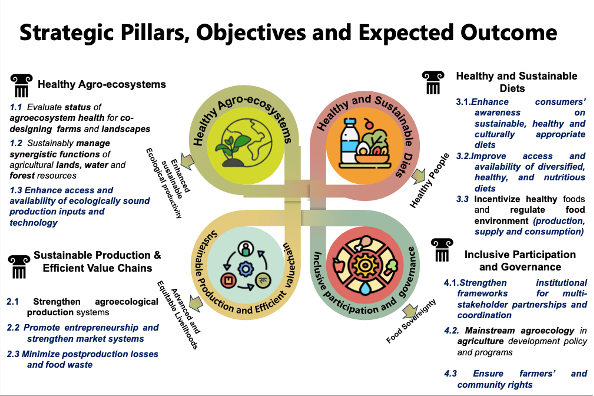
Framework of Nepal’s Agroecology Roadmap
Based on the 13 principles of agroecology and the HAI Theory of Change, Nepal’s Agroecology Roadmap comprises five structural levels:
- Vision: Agroecology for equitable, resilient and sustainable food systems
- Strategic pillars: Four strategic pillars to complement the vision
- Strategic objectives: Definitions of the key objectives of each strategic pillar
- Action areas: Key action areas to meet each strategic objective, and
- Intervention: Key interventions to meet each key action area.
Strategic directions of the National Agroecology Roadmap
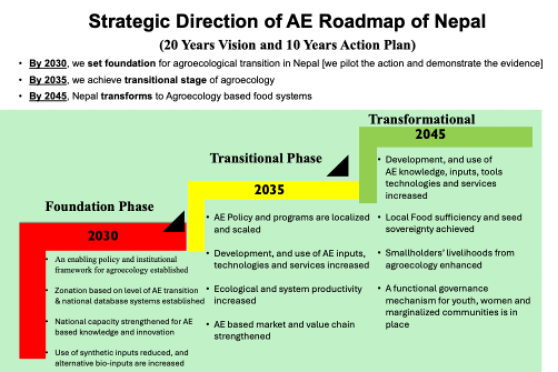
Nepal’s roadmap carries a 20-year vision to be realised in three phases and includes a 10-year Action Plan:
- By 2030, Nepal will set a foundation for the agroecological transition
- By 2035, Nepal will achieve transitional stage of agroecology
- By 2045, Nepal will have transformed to agroecological food systems
Monitoring progress of transition
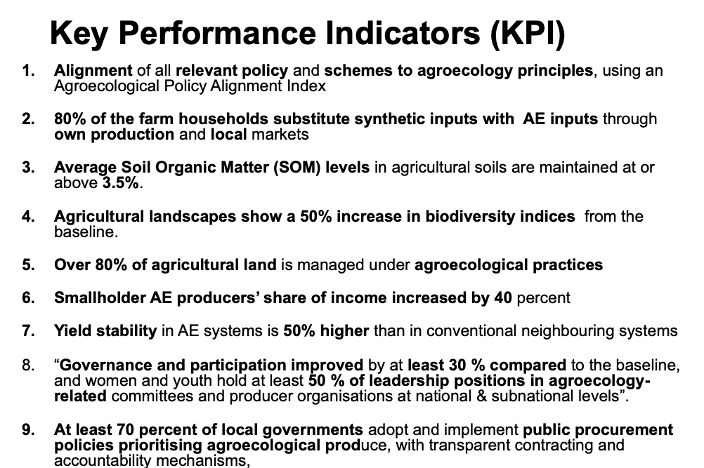
Dr. Gauchan presented on a few selected key performance indicators for monitoring the progress of agroecological transition in Nepal. These indicators can be roughly divided into three categories:
- enabling public policies and governance
- effect on smallholder farmers, women and youth, and
- shift to agroecolgical practices and their effect on soil and farmland.
Additional indicators, including those tracking system-level progress, are being discussed. The list of indicators discussed at the meeting, is available below:
At the end of his presentation, Dr. Gauchan emphasised that Nepal has an enabling environment for transition, with the Strategic Plan for Food Systems Transformation (2025-2030) now approved and other key national policies and strategies under revision. Provincial initiatives are also emerging, including the goal of Karnali Province to go fully organic, complemented by the new IFAD Resilient High-Value Agricultural Programme (R-HVAP) project in western Nepal, which focuses on laying the foundation for agroecology farms and villages.
Resources
Access the presentation here.
The Himalayan Agroecology Initiative is a strategic endeavour that works closely with governments and with the support of a broad group of stakeholders, to support the emergence of multi-stakeholder processes that develop, build capacities and facilitate the implementation of agroecological food systems roadmaps. Other participating countries in the Himalayan Agroecology Initiative, besides Nepal, are India and Bhutan. Its main aim is to improve livelihoods and sustainability and to empower farmers, farmer producer organisations and other key stakeholders so they better benefit of public policies, including those that support organic and natural agriculture, food processing, marketing, distribution and consumption.